
There can be a lot of goals when a business runs an advertising campaign, but it’s undeniable that the prime goal is to gain more revenue. One way to measure business earnings is by calculating the Return on Ad Spend (ROAS).
Apart from tracking the CTR, response rates, and conversions, and calculating the overall ROI, maximizing the ROAS is essential for any advertising campaign.
What is Return On Ad Spend
The Return on Ad Spend (ROAS) is a marketing metric that measures how much you earn from every advertisement you run for your business.
ROAS measures how effectively you are spending your every dollar on your marketing or advertising. It specifically looks at the cost of the ad campaign and not at the overall expenses incurred by the business, unlike ROI.
Return On Ad Spend vs ROI
Though ROAS is similar to ROI, they actually use different factors to get the intended results.
The Return on Investment (ROI) looks at the overall investment of the business to evaluate the overall effectiveness of all the marketing efforts.
ROAS, on the other hand, only looks at the cost of the ad to evaluate the effectiveness of one particular ad campaign. So, if you want to identify which ad campaign is worth your time and money, you can use ROAS.
ROAS is an effective metric to determine which ad you should spend your dollars on.
Why Calculate ROAS
Sure, you can employ various marketing campaigns and get conversions, but you won’t get clear insights into your campaign ads.
Tracking and calculating the return on every ad spend, however, will give you a clearer view of every ad campaign you run. With ROAS, you can investigate why a certain campaign generates more revenue than the others.
Furthermore, it helps you determine how a particular ad campaign is contributing to your brand’s net income. Without it, you are only guessing whether your ad campaign is generating more revenue than cost.
ROAS helps you identify better ways to allocate your budget. If you are working on a tight budget, ROAS will help you identify the profitable ad campaigns.
How to Calculate Return On Ad Spend
To determine your ROAS on a specific campaign, you only have to remember two metrics. The first one is the cost of ads, and the second one is the revenue generated by ads.
We can simply put the Return On Ad Spend formula as:
ROAS = Total Ad Revenue / Total Ad Cost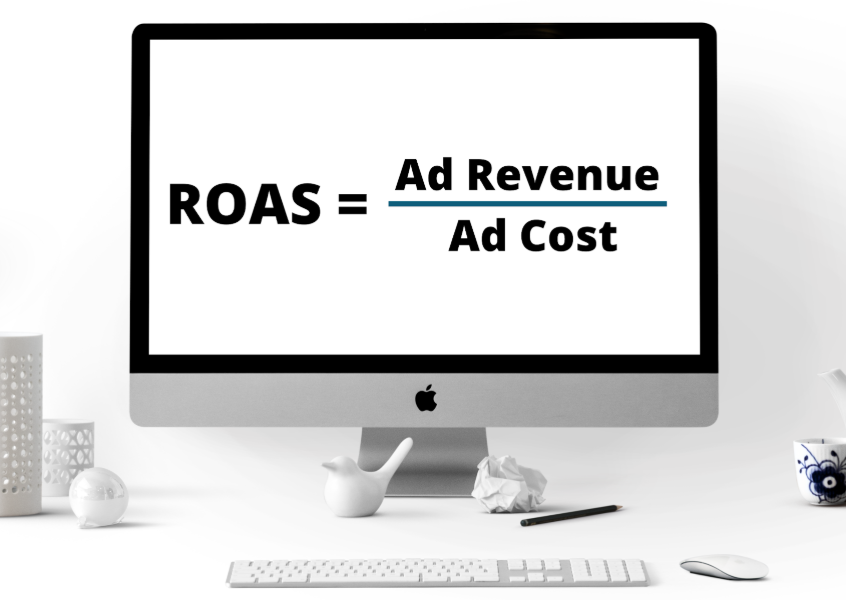
This formula gives you a ratio that can be used to determine whether your marketing campaign is effective or not. If an ad campaign generates $10,000 revenue after a $200 cost, then your ROAS is 5:1.
But of course, in order to be able to calculate the campaign’s ROAS, you have to track first the conversions and sales information for that specific campaign. Fortunately, most ad platforms make this an easy process.
To track Google Ads campaigns, you can get the data you need on the Ad Groups page of the main dashboard. After you gather the conversion and sales information, you can immediately compute the campaign’s ROAS.
What is a Good Return On Ad Spend
ROAS varies from campaign to campaign. Therefore, there is really no single “good” return on ad spend as different campaigns produce different results.
But as a general rule, a ROAS of 4:1 or higher signifies a successful campaign and a ROAS of 3:1 shows a mediocre result which may urge you to take a deeper look at your ROAS and check possible flaws of the information you have.
Bear in mind that your ROAS result is highly dependent on the metrics you have considered to calculate. Make sure you are attributing the revenue and cost correctly.
How to Improve Your ROAS
When you get a low ROAS on one or two of your campaigns, do not stop the campaigns immediately. Instead, review the factors involved in calculating the ROAS to get credible insights on the results, as well as to make a better decision.
1. Review ROAS Accuracy
The first step to improve your ROAS is to check the accuracy of the metrics involved. Check if you have considered all the costs of your advertising.
Inaccurate Return On Ad Spend can unnecessarily lead to canceling the highly competitive campaign.
2. Lower the Cost of Your Ads
One of the factors that you should look into is the cost of your ads. If you can lower your ad cost, you can surely improve your Return On Ad Spend.
You may lower your ad cost by checking if you’re targeting the right keywords.
For example:
If you are running a Google Ads campaign, you may check if you are wasting ad spend on keywords you don’t want to target. You may eliminate those unwanted keywords, or you may add negative keywords instead.
Say you are running an ad campaign for the phrase “Baby Shoes,” but you don’t sell booties and leather shoes, you may add those terms to the negative keyword list to prevent your ad from showing up on search engines for queries related to those keywords.
Adding negative keywords helps improve the relevancy of the traffic your ads bring in, thus improving your return on ad spend.
3. Increase the Revenue Generated by Ads
Another way to improve your Return On Ad Spend is to increase the revenue generated from your ads by checking on the other metrics like Clickthrough Rate (CTR) and Cost-Per-Click (CPC) to see where your ads are going wrong.
If an ad has a high CTR and a low ROAS, the issue might be your landing pages. Lead with a strong CTA and make sure to use the same language on both the ad and landing page.
Bottomline
There are a lot of metrics you can use to measure your ad campaign’s effectiveness. Yet, the most accurate method to determine whether your ads are really worth the investment is by tracking and calculating ROAS in line with other digital marketing metrics, such as CTR and CPC.